Showing posts with label animal hospital. Show all posts

Frequently Asked Questions


Related image


Here are some questions/answers that we are frequently asked. If you have additional questions that aren't covered here, please feel free to give us a call at (315)446-1200.

1. What are the Hospital hours?

Our hospital is open Monday to Friday from 8:00am to 9:00pm. On Saturdays we are open from 8:00am until 4:00pm. On Sundays we are open 8:00am to 12:00pm and 6:00pm to 8:00pm.

2. Do I need to have an appointment?
Yes. Appointments should be made in advance. We have a Doctor available Monday - Saturday.

3. What forms of payment do you accept?
Cash, Check, Mastercard, Visa, Discover and Care Credit

4. Can I make payments?
Payment is required at the time of service.

5. At what age can I have my pet spayed or neutered?
Spaying or neutering can be done at approximately 5 months of age. Your pet is given an exam prior to surgery to help determine whether your pet is healthy enough to undergo the surgical procedure. Current vaccinations are required at the time of surgery. Also a pre-anesthetic blood screen is recommended prior to undergoing anesthesia and surgery.

6. What is the pre-anesthetic blood screening?
This is a blood test that is run here in the clinic prior to surgery. It tests the organ functions, blood counts and clotting function of your pet. The pre-anesthetic blood screening is done to assure safety during surgery and the ability to heal following surgery.

7. How long do the sutures stay in after my pet's surgery?

Procedures involving sutures require them to be removed in 10-14 days following the surgery.

8. Is it a good idea to let my pet have at least one litter?

No, there is no advantage to letting your pet have one litter. However there are plenty of advantages to having you pet spayed or neutered. These advantages include decreasing the chances of breast tumors later in life, decreasing the chance of cystic ovaries and uterine infections later in life, decreasing the desire to roam the neighborhood, decreasing the incidence of prostate cancer later in life, helping prevent spraying and marking, and also decreases the surplus of unwanted puppies and kittens.

9. Do you board pets?

Yes, we do boarding for our clients. We have boarding space for both dogs and cats. We also can board birds and other small animals, but you will be required to bring your own cage and food for your pet.

10. What are your kennels like?

Our dog kennels are indoor/outdoor. The dogs are let outside within their individual kennel 3 times daily while they are boarding. The cat boarders are housed in a separate area away from the dogs. Blankets and food are provided for our boarders, but you are always welcome to bring your own.

Sign up for our online pet portal.

Image result for epethealth 
Did you know you can easily sign up for an online pet portal? This portal gives you access to the pets on your account with our clinic. Here you can find their medical records, Rx refill requests,
information about your pet's breed, and more!  

Did You Know?

Did you know:
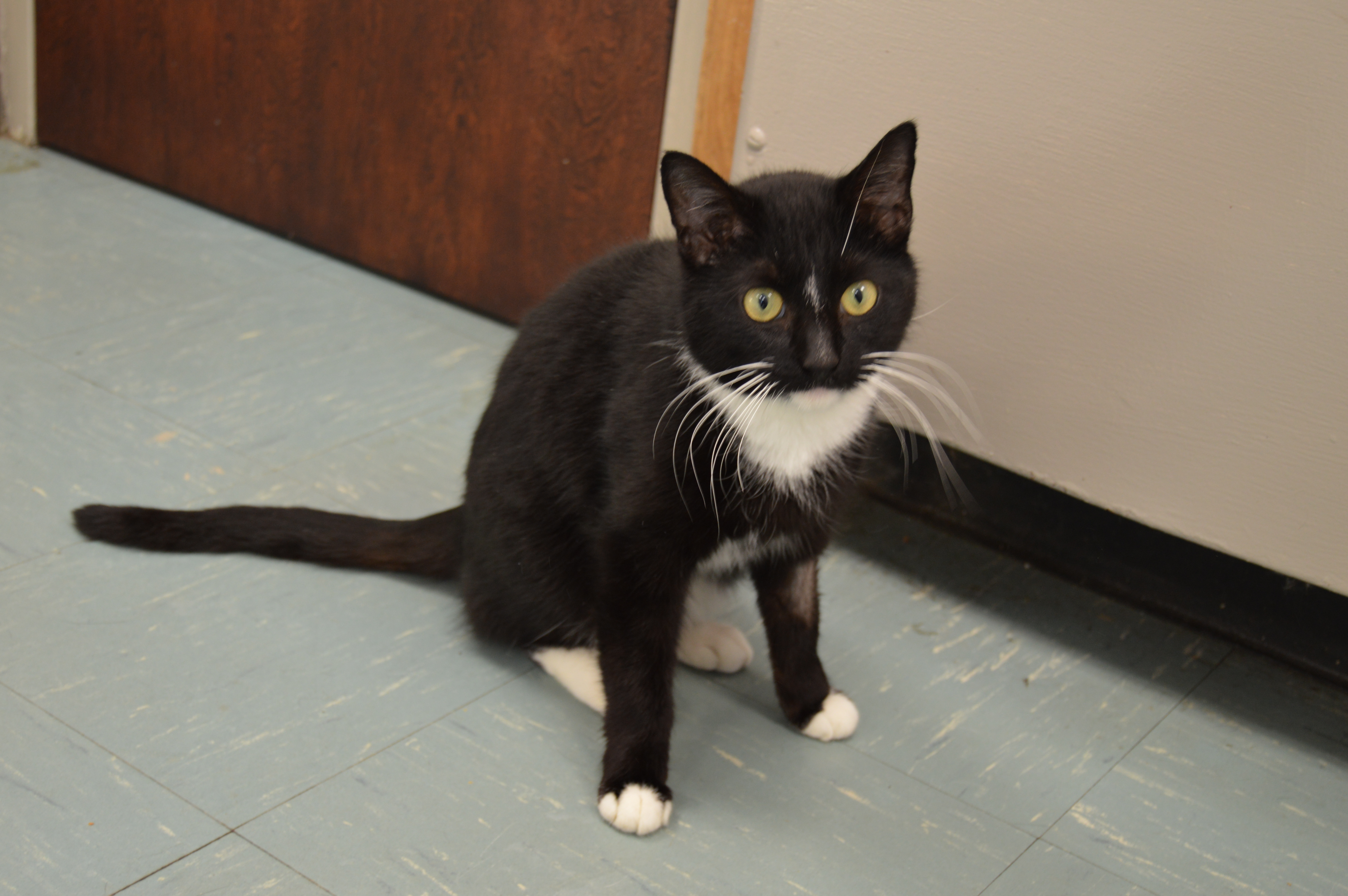
In addition to being a full-service veterinary clinic, we are also the animal shelter for the City of Syracuse! Check our our adoptable dogs and cats on Petfinder!


Java 1 
Adopt Java here!

Friends of Animals Program


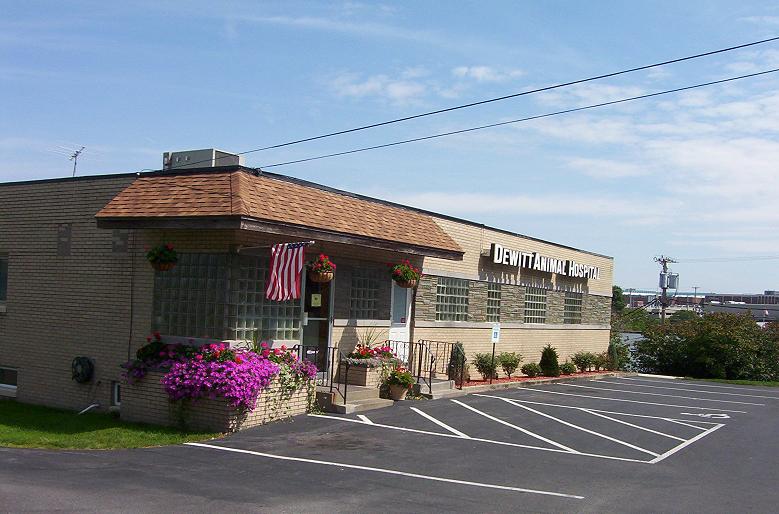
At the DeWitt Animal Hospital we are proud to participate in the Friends of Animals Spay/Neuter certificate program. This program helps to make spay/neuter surgeries more affordable so that each pet owner can help in the decline of pet overpopulation.

Employment Opportunities

 Image result for veterinarian


We are always glad to accept resumes from enthusiastic, hard working, dependable, team oriented people who wish to join our team of veterinary health care professionals.

Positions for which we may have openings include:

RECEPTIONISTS
Responsibilities include scheduling appointments, answering the telephone, setting up new clients and patients, preparation and maintenance of medical records, admitting and discharging patients, filling some prescriptions, over the counter sales, mailings, computer operation, financial transactions, filing, and front office and reception area maintenance.  Receptionists will assume the responsibility for acquiring the medical and legal information necessary for the performance of their duties.

VETERINARY TECHNICIANS
Technicians are responsible for hospital maintenance, assisting the doctors, laboratory procedures, radiology, client communication, medical procedures, pharmacy, operation and maintenance of instruments and equipment, inventory, daily treatment of hospitalized patients, rehabilitation, assisting in the operating room and maintenance of the OSHA and Hazardous Materials programs.

VETERINARY ASSISTANT
Ward personnel are responsible for animal handling, bathing and grooming, cleaning, feeding, laundry, waste disposal, and assisting with animal restraint.

Check out website regularly for open positions here.

Meet Dr. Robert Wilcox

Robert Wilcox: DVM/ Owner

Dr. Wilcox started his career in veterinary medicine as a Veterinary Assistant at the DeWitt Animal Hospital under the supervision of Dr. C. Barry Quinn. After completing his bachelors degree at LeMoyne College he attended vet school at the University of the Philippines. Dr. Wilcox graduated valedictorian of his class and received his Doctorate in Veterinary Medicine. Dr. Wilcox has been the owner and primary veterinarian at DeWitt Animal Hospital for over 16 years. He resides in Lafayette with his two dogs, Trevor and Penny.

Hours of Operation


Hours of Operation
Doctor's Hours (Appointments preferred)Monday - Friday:  10:30 AM - 12:00 PM and 2:30 PM - 5:00 PM 
Saturday: 10:30 AM - 1:00 PM 
Boarding Pick-Up/Drop-Off Hours
Monday - Friday8:00 AM - 9:00 PM 
Saturday: 8:00 AM - 4:00 PM 
Sunday: 8:00 AM - NOON and 6:00 PM - 8:00 PM 
Adoption Viewing Hours 
Monday - Friday: 12:30 PM - 2:00 PM and 5:30 PM - 7:30 PM 
Saturday: 1:30 PM - 3:30 PM

Sunday: 9:30 AM - 11:30 AM

In Case of an Emergency


If you have an emergency outside of our regular business hours, we recommend that you contact one of the following emergency facilities:

Veterinary Medical Center

5841 Bridge Street
Suite 200
East Syracuse, New York 13057 United States
Phone : (315) 446-7933

Veterinary Emergency & Critical Care Center

2115 Downer Street Road
Baldwinsville, New York 13027 United States

Phone : (315) 638-3500

Pet Costume Ideas

 Dog Costume

Cat Costume

Are you dressing up your pets for Halloween, like a shark costume for a dog and a lion costume for a cat?
De Witt Animal Hospital wishes you a fun and safe Halloween weekend with your pets!

Why You Should Adopt


Because you'll save a life. Each year, 2.7 million adoptable dogs and cats are euthanized in the United States, simply because too many pets come into shelters and too few people consider adoption when looking for a pet.

Because you'll get a great animal.
Animal shelters and rescue groups are brimming with happy, healthy pets just waiting for someone to take them home. Most shelter pets wound up there because of a human problem like a move or a divorce, not because the animals did anything wrong. Many are already house trained and used to living with families.

See more reasons why.


Our shelter

We are the official shelter for the City of Syracuse. We receive animals through Syracuse Dog Control that may be lost or injured. We accept donations through Paypal to help care for these animals. We are not a 501(c)3 organization therefore donations are not tax deductible. No goods or services are exchanged for donations.

Patient Arrival Policy

For the safety of all animals in our care, we require that all vaccinations be up to date. Even though we make every effort to make our patients feel comfortable during visits, they may be a little uneasy about new people, new surroundings and other pets. This is one of the reasons we ask you to restrain your pet. We recommend that animals be placed on a leash or in pet carriers before entering the waiting room.
For your protection, and that of others, all dogs must be on a leash and properly controlled while in the waiting area or exam rooms.
All cats must be presented in an appropriate cat carrier.

Hours of Operation

Doctor's Hours (Appointments preferred)
Monday - Friday:  10:30 AM - 12:00 PM and 2:30 PM - 5:00 PM
Saturday: 10:30 AM - 1:00 PM
Boarding Pick-Up/Drop-Off Hours
Monday - Friday: 8:00 AM - 9:00 PM
Saturday: 8:00 AM - 4:00 PM
Sunday: 8:00 AM - NOON and 6:00 PM - 8:00 PM
Adoption Viewing Hours 
Monday - Friday: 12:30 PM - 2:00 PM and 5:30 PM - 7:30 PM
Saturday: 1:30 PM - 3:30 PM
Sunday: 9:30 AM - 11:30 AM

Pet care

Because of the shorter lifespan of our pets, we stress the importance of an annual physical examination. Thorough check-ups and preventive care can help alleviate serious health problems. We offer a wide range of veterinary services to keep your companions feeling their best.

Boarding


We provide pet boarding as a service to our clients. All boarders receive personal attention from our caring staff. Pets may be dropped off and picked up during regular business hours seven days a week. Please see our Boarding Requirements page for further information >> https://goo.gl/YnteuV

A Pet Safe Halloween Is A Happy Halloween


It’s that time again. For goblins and ghosts, pumpkins and pranks, and things that go bump in the night. But as responsible pet owners, please ensure that your dogs and cats aren’t innocent victims of Halloween’s fun and frolics.

Consider the following suggestions to keep your pets safe not sorry:

Keep candy out of reach of your pet. Chocolate, especially dark or baking chocolate, can prove toxic for both dogs and cats. Candy containing the artificial sweetener, xylitol, can also cause problems. If you suspect your pet has ingested something toxic, please call your veterinarian or the ASPCA Animal Poison Control Center at (888) 426-4435.
 
Although pumpkins and decorative corn are considered relatively non-toxic, they can still produce an upset stomach if nibbled on by your pet.

Keep wires and cords from lights and other decorations out of reach of your pet. If chewed, your pet might be cut or burned or receive a potentially life-threatening electric shock.

Although festive, carved pumpkins with candles inside can be easily knocked over by your pet and a fire started. Curious kittens in particular run the risk of being singed or burned by a candle flame.

Keep costumes for your children and away from your pets unless you’re certain they’re comfortable being decked out, not stressed out, by putting on the “glitz”. Or opt for a Halloween-themed bandana draped round your pet’s neck.

Keep all but the most social dogs and cats in a separate room when “trick or treaters” come to call. Even then, take care that your pet doesn’t dart outside when the door first opens.

Should your pet “pull a Houdini” and vanish, ensure that he/she has either been micro chipped or is wearing a collar and tags for proper identification and a swift return to your anxious arms.

With some strategic planning beforehand, you and your pet can be assured of spending the safest and happiest of Halloweens together.

Dogs – Positive Reinforcement Training

Remember how happy you were if your parents gave you a dollar for every A on your report card? They made you want to do it again, right? That's positive reinforcement.

Dogs don't care about money. They care about praise … and food. Positive reinforcement training uses praise and/or treats to reward your dog for doing something you want him to do. Because the reward makes him more likely to repeat the behavior, positive reinforcement is one of your most powerful tools for shaping or changing your dog's behavior.

Rewarding your dog for good behavior sounds pretty simple, and it is! But to practice the technique effectively, you need to follow some basic guidelines.

Timing is Everything
Correct timing is essential when using positive reinforcement. The reward must occur immediately—within seconds—or your pet may not associate it with the proper action. For example, if you have your dog sit but reward him after he's stood back up, he'll think he's being rewarded for standing up.


Using a clicker to mark the correct behavior can improve your timing and also help your dog understand the connection between the correct behavior and the treat.

Keep it Short
Dogs don't understand sentences. "Daisy, I want you to be a good girl and sit for me now" will likely earn you a blank stare.

Keep commands short and uncomplicated. The most commonly used dog commands are:
  • Watch Me  Sit
  • Stay
  • Down (which means "lie down")
  • Off (which means "get off of me" or "get off the furniture")
  • Stand
  • Come
  • Heel (which means "walk close to my side")
  • Leave It
Consistency is Key
Everyone in the family should use the same commands; otherwise, your dog may be confused. It might help to post a list of commands where everyone can become familiar with them. Consistency also means always rewarding the desired behavior and never rewarding undesired behavior.

When to Use Positive Reinforcement
The good:
Positive reinforcement is great for teaching your dog commands, and it's also a good way of reinforcing good behavior. You may have your dog sit:
  • before letting him out the door (which helps prevent door-darting)
  • before petting him (which helps prevent jumping on people)
  • before feeding him (which helps teach him good meal-time manners)
Give him a pat or a "Good dog" for lying quietly by your feet, or slip a treat into a Kong®-type toy when he's chewing it instead of your shoe.

The bad:
Be careful that you don't inadvertently use positive reinforcement to reward unwanted behaviors. For example, if you let your dog outside every time he barks at a noise in the neighborhood, you're giving him a reward (access to the yard) for behavior you want to discourage.

Shaping Behavior
It can take time for your dog to learn certain behaviors. You may need to use a technique called "shaping," which means reinforcing something close to the desired response and then gradually requiring more from your dog before he gets the treat.

For example, if you're teaching your dog to "shake hands," you may initially reward him for lifting his paw off the ground, then for lifting it higher, then for touching your hand, then for letting you hold his paw, and finally, for actually "shaking hands" with you.

Types of Rewards
Positive reinforcement can include food treats, praise, petting, or a favorite toy or game. Since most dogs are highly food-motivated, food treats work especially well for training:
  • A treat should be enticing and irresistible to your pet. Experiment a bit to see which treats work best for your pet.
  • It should be a very small (pea-size or even smaller for little dogs), soft piece of food, so that he will immediately gulp it down and look to you for more. Don't give your dog something he has to chew or that breaks into bits and falls on the floor.
  • Keep a variety of treats handy so your dog won't become bored getting the same treat every time. You can carry the treats in a pocket or fanny pack.
  • Each time you use a food reward, you should couple it with a verbal reward (praise). Say something like, "Yes!" or "Good dog," in a positive, happy tone of voice. Then give your dog a treat.
If your dog isn't as motivated by food treats, a toy, petting, or brief play can be very effective rewards.

When to Give Treats
When your pet is learning a new behavior, reward him every time he does the behavior. This is called continuous reinforcement. Once your pet has reliably learned the behavior, you want to switch to intermittent reinforcement, in which you continue with praise, but gradually reduce the number of times he receives a treat for doing the desired behavior.

At first, reward him with the treat four out of every five times he does the behavior. Over time, reward him three out of five times, then two out of five times, and so on, until you're only rewarding him occasionally.

Continue to praise him every time—although once your dog has learned the behavior, your praise can be less effusive, such as a quiet but positive, "Good dog."

Use a variable schedule of reinforcement so that he doesn't catch on that he only has to respond every other time. Your pet will soon learn that if he keeps responding, eventually he'll get what he wants—your praise and an occasional treat.

Caution! Don't decrease the rewards too quickly. You don't want your dog to become frustrated. By understanding positive reinforcement, you'll see that you're not forever bound to carry a pocketful of goodies. Your dog will soon be working for your verbal praise, because he wants to please you and knows that, occasionally, he'll get a treat, too.

Dangerous Plants for Your Pet


Some of the flowers and plants growing in your garden or blooming in your vases could cause serious harm to your pet. It is important for all dog and cat owners to be extra vigilant about keeping dangerous plants out of their homes and gardens. Here are a few plants that you need to be aware of -

Lililes:
You may be tempted to decorate your home with a beautiful bouquet of lilies, but doing so could spell trouble for your cat. Members of the true lily (Lilium) and day lily (Hemerocallis) families have been shown to cause acute kidney failure in felines. Cats often vomit within a few hours of exposure and become lethargic.

Daffodils:
These plants contain lycorine and other alkaloids that can be poisonous for dogs and cats. The toxins are mostly in the plant’s bulb and, if ingested, can lead to vomiting, salivation and diarrhea. If your animal ingests large amounts of the plant, signs of toxicity may include cardiac arrhythmias (irregular heartbeats), convulsions/tremors and low blood pressure.
 
Sago Plants:
Sago palms (Cycads, Macrozamia and Zamia spp.) are often outdoor ornamental plants in warm climates or houseplants in cooler climes. Ingestion of this highly toxic plant can cause liver failure and death in dogs and cats. All parts of the plant are toxic, with the seeds having the highest concentration of toxin. All it takes is one to two seeds to cause clinical signs and possibly death in a dog. Vomiting usually begins within 24 hours, and animals may eventually become depressed and start to seizure. This plant is one of the most toxic, with a mortality rate of around 50 percent.

Tulips:
Most of the toxins in tulips (Liliaceae spp.) are concentrated in the bulbs, so if your dog is a digger or your cat frequents your flower beds, you should be especially cautious about keeping this flower out of your garden. Signs of toxicity can include vomiting, diarrhea, excessive drooling and depression.
  
Buttercups:
You may dream of frolicking through a meadow of buttercups (Ranunculus spp.) with your dog or cat, but should your animal nibble on this flower, it could lead to vomiting, diarrhea, anorexia, excessive salivation and a drunken gait.

If you suspect your dog or cat has ingested a toxic plant, call the ASPCA Animal Poison Control Center hotline at 888-426-4435 and contact your De Witt Animal Hospital Veterinarian at 315-466-1200. It's always better to be safe then sorry!